New Home Office rules measure universities through immigration compliance metrics while ignoring how surveillance and immigration control shape international students’ lives and chances of success.
Nando Sigona
Over the past decade, employers, landlords, banks, universities and even healthcare providers have been enlisted into the machinery of immigration control. Through the hostile environment and its successors, border enforcement has progressively moved away from the border itself and into everyday institutions. Universities have long been part of this system through sponsorship duties and attendance monitoring requirements. But the latest announcement from the Home Office represents a further step in this direction.
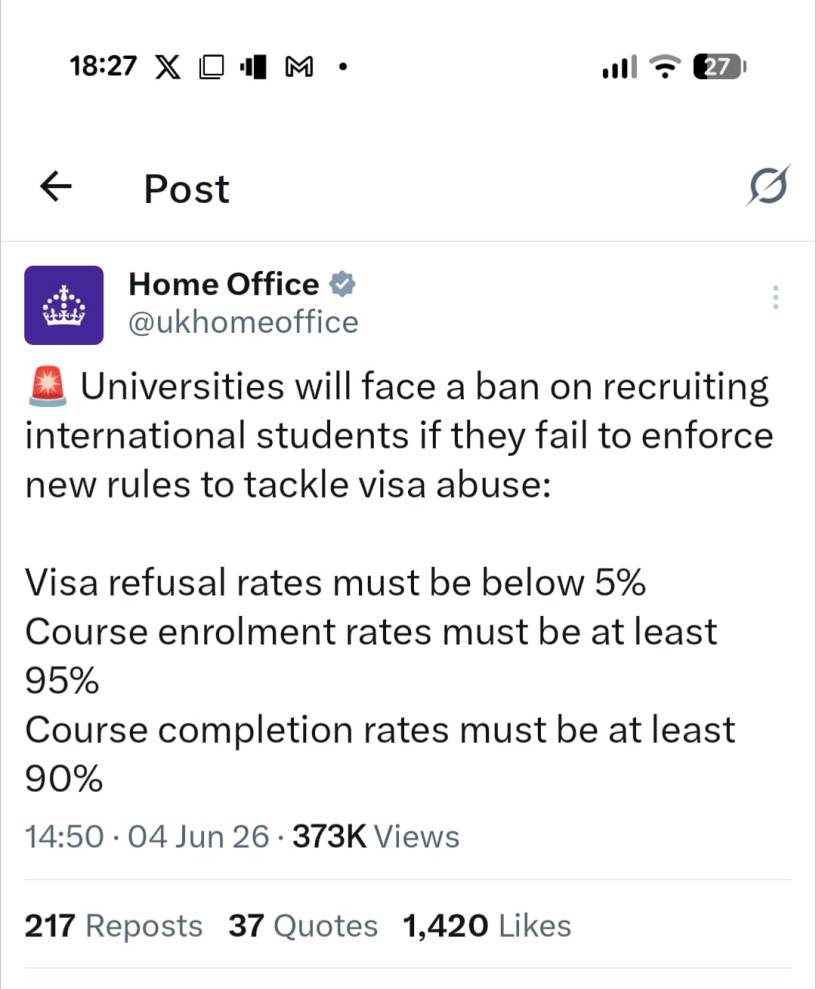
Under new rules announced this week, universities face losing the right to recruit international students if they fail to meet stricter immigration compliance metrics. Sponsors will now be expected to maintain a visa refusal rate below 5 per cent (down from 10 per cent), an enrolment rate of at least 95 per cent (up from 90 per cent), and a course completion rate of at least 90 per cent (up from 85 per cent).
The announcement is framed as a response to “visa abuse”. Yet it also points to the growing role of the Home Office in areas that have traditionally fallen within the remit of higher education policy.
One example concerns the visa refusal rate. Visa refusals are decisions made by the Home Office itself. Universities can assess applicants, verify qualifications and provide support, but they do not decide whether a visa is granted. Institutions are therefore being assessed, in part, on outcomes that remain outside their direct control.
The enrolment and completion metrics raise a different set of questions. Whether students enrol and complete their studies depends on a wide range of factors, including academic preparedness, financial pressures, housing conditions, mental health, family circumstances and the quality of educational support. These are educational outcomes. They are not, in themselves, immigration outcomes.
Through these metrics, the Home Office is not simply enforcing immigration rules; it is also influencing how university performance is assessed. Questions about course quality, student retention and educational success have traditionally been the responsibility of educational regulators and government departments responsible for higher education. The new framework blurs these boundaries.
The announcement also comes at a time when universities across the UK are facing significant financial pressures. International students have become an important source of income, helping to sustain teaching and research in a sector grappling with frozen domestic fees and rising costs. Rather than leaving questions about university performance and financial sustainability to the bodies responsible for higher education policy, the Home Office has introduced a Red-Amber-Green compliance framework that could make universities increasingly subject to scrutiny and sanction on the basis of immigration compliance metrics.
The effects may not be distributed evenly across the sector. Faced with the prospect of sanctions, universities may become more cautious in their recruitment strategies. We are already seeing evidence of institutions restricting recruitment in some markets because of concerns about compliance metrics. What is presented as a neutral administrative exercise may therefore shape who is able to access British higher education and on what terms.
There is also a deeper question that is largely absent from the current debate. What does it mean to study under a system of continuous immigration monitoring?
International students already navigate a uniquely intensive set of compliance requirements. Universities monitor attendance. Banks verify immigration status. Landlords conduct right-to-rent checks. A range of institutions become involved in the governance of migration status. These arrangements are often presented as routine administrative measures, yet they also shape everyday experiences of security, belonging and wellbeing.
This matters because the Home Office now proposes to use completion rates as an indicator of institutional performance while paying little attention to the ways in which immigration governance itself may shape students’ experiences. Anxiety, uncertainty and bureaucratic scrutiny are not incidental features of the system. They form part of the environment in which international students live and study.
More fundamentally, the debate raises questions about the purpose of the university. Universities are not simply mechanisms for delivering economic growth or managing migration flows. They are places of learning, intellectual exchange and personal development. They are institutions that bring together people from different countries and backgrounds, creating forms of knowledge, connection and understanding that extend well beyond the classroom.
International students contribute enormously to these communities. Yet policy discussions increasingly approach them through the language of compliance, risk and control. The danger is not only that universities become more cautious in whom they recruit, but also that students themselves come to be seen less as members of academic communities than as subjects of immigration management.
One might have expected other departments to play a more visible role in this debate. Questions about educational quality belong with the Department for Education. Questions about the contribution of international students to innovation, trade and economic growth extend well beyond the Home Office. Yet there appears to be little political appetite for challenging the expanding role of immigration policy in shaping higher education.
Whether these measures will achieve their stated objective remains uncertain. What is clearer is that they continue a longer trend in which immigration considerations increasingly shape the governance of institutions whose primary purpose lies elsewhere.
Universities should, of course, comply with immigration law. But they should also remain places where students are first and foremost learners, scholars and members of academic communities. Any discussion of student success ought to begin from that principle.

